
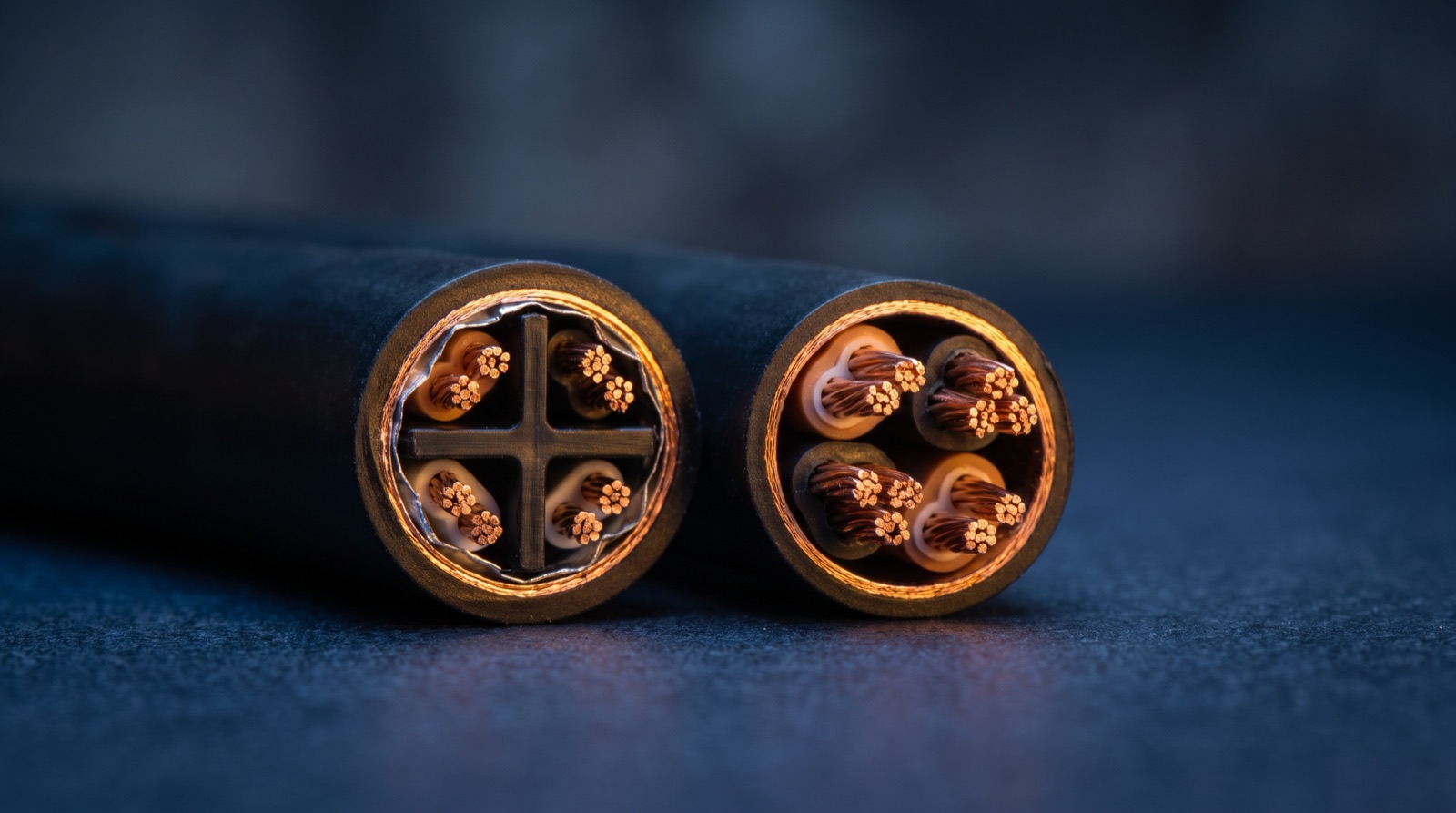
Structured cabling is the most disruptive infrastructure layer to replace in a building. Active equipment is renewed every three to five years, but the copper inside the walls stays in place for 15-20 years. That is why the decision between Cat6 and Cat6A should be driven not by today's needs, but by the traffic of 10 years from now.
The technical difference is, in short, bandwidth: Cat6 is tested to 250 MHz, Cat6A to 500 MHz. In practice this means the following — Cat6 comfortably carries 1 Gbit/s traffic over 100 meters, whereas 10GBASE-T is supported over Cat6 only up to 55 meters and under favorable conditions. Cat6A guarantees 10 Gbit/s across the full 100-meter channel and is tested against alien crosstalk from neighboring cables.
One of the decision points is the wireless infrastructure. Wi-Fi 6/6E/7 access points have begun to push past the 1 Gbit/s limit on a single uplink; new projects now call for links supporting 2.5/5/10 Gbit/s to feed access points. Likewise, high-resolution IP camera backbones, video processing servers and links between floor distribution risers scale without additional investment when built with Cat6A.
PoE and the heat factor
Today, cabling carries not only data but power as well. With PoE++ (IEEE 802.3bt), 60-90 W per port creates measurable heating in cable bundles. The thicker conductor cross-section and improved construction of Cat6A cable lower the temperature rise inside the bundle; in projects with dense PoE loads (lighting, access points, cameras), this alone is reason enough to choose it.
On the cost side, Cat6A is 20-40 percent more expensive at the cable and connector level, and because the cable diameter is larger, tray and conduit fill calculations must also be revised. Labor, on the other hand, is nearly identical, and within the total project budget the difference usually stays at the level of a few percent. Our recommendation is clear: in buildings with dense backbones and long technology lifecycles, Cat6A should be adopted as the standard; and in either scenario, every link should undergo channel testing with a field certifier after installation and be documented in a test report.