
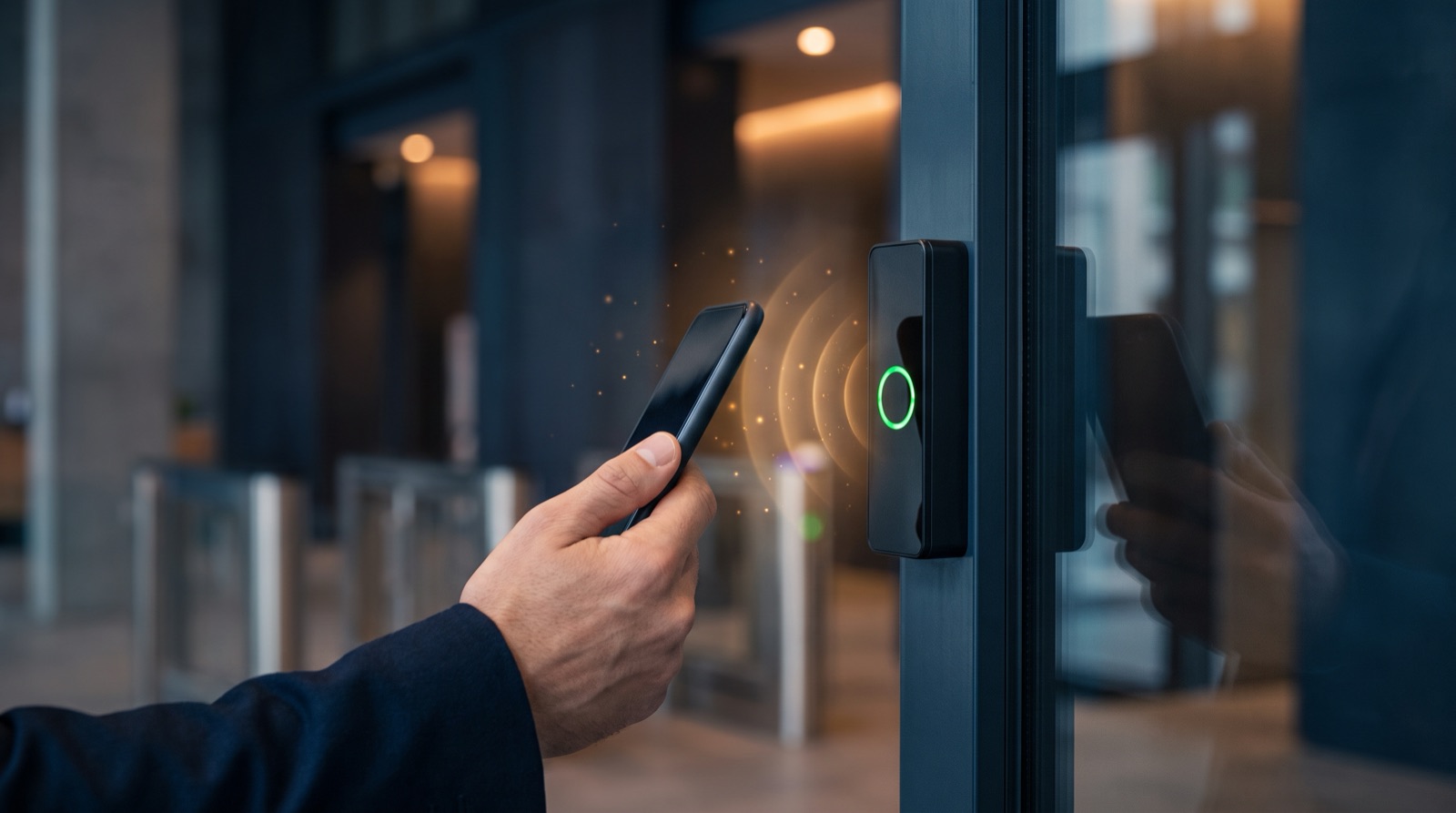
The card-and-reader duo that has dominated the access control industry for decades is rapidly giving way to mobile credentials. Having the phone present its identity to the reader over NFC or Bluetooth Low Energy (BLE) spares users the hassle of pulling a card out of their pocket, and spares the business the entire card printing and distribution operation.
The first tangible gain of mobile credentials is security. The 125 kHz proximity cards still widespread in the field are unencrypted technologies that can be cloned in a matter of seconds. A mobile credential, by contrast, is stored in a secure area on the device, communication between the reader and the phone is encrypted on a per-session basis, and cloning the credential is practically impossible. When a phone is lost, the credential does not remain "valid until cancelled" the way a card does; it is revoked instantly and remotely from the management console.
The second gain is operational. A new employee's credential is provisioned within minutes via an email invitation, with no card printing or hand delivery to wait for. Visitor and contractor access is managed with temporary credentials restricted by date and time. In multi-site companies, a single credential works across all facilities; card inventory, lost-card fees and collection processes cease to exist as cost items.
Points to watch in system design
The first rule of the transition is to proceed in stages: existing card-based systems are not ripped out overnight. Dual-technology readers that accept both cards and mobile credentials manage the transition period smoothly. The line between the reader and the panel must be modernized as well; instead of the legacy Wiegand interface, which is open to cloning, encrypted and supervised OSDP must be the choice — otherwise the security gained through mobile credentials is lost in the cable behind the door.
Scenarios such as a dead phone battery, app permissions and corporate device policies must also be factored into the planning; on critical doors, a second method such as a PIN or card is kept as a fallback. Finally, data protection (KVKK) must not be overlooked: access logs are personal data, and retention periods and access rights must be reflected in the organization's privacy notice. Configured correctly, mobile access control is an infrastructure that is both more secure and visibly cheaper to operate.